Friday, December 16, 2016

Shirin's Story


In my family history meanderings, I sometimes forget that the living have stories too. None of us are getting any younger - none of us ever gets younger. We should gather these stories now.
 
My mother-in-law Shirin Dastur Patel turned 90 this year, can no longer walk, and recently moved to an assisted living facility. It was a hard year. She even stopped reading, her lifetime joy. During one of my trips to pack her things, I suggested we get her story on paper, so her grandchildren would have a written account of her life. I was resolute, and although at first I had to pry information from her and she showed no interest in my notes, on my last visit she carefully reviewed my draft and made changes.

I have known Shirin for more than thirty years. I knew she lived through a remarkable time in history, but as I looked over my notes and spent time doing a bit of internet research, I realized how little I still know about the India of her youth. Her personal story made that history more alive to me, and I look forward to learning more.


Life in India (click here) 


Shirin was born on the western coast of India 21 Oct 1926. She is a "Parsee", part of the large group of people of the Zoroastrian faith that migrated from Persia (now Iran) to India a thousand years ago. During Shirin's lifetime in India she witnessed British colonial rule, the Second World War, and the Partition of India. She was educated in India and at Oxford.

Shirin and her husband Jal Kaikhashru Patel (1 Mar 1927 - 31 May 1986) left India for America in 1967 so they could better educate their sons. The Indian government allowed them to take $100 each, and a Greyhound Bus pass. They rebuilt their lives as immigrants. They educated their sons well. And now those sons are married and have children of their own.

Today, Shirin is happier with her new home. She is reading again, primarily newly published histories of India. Shirin's written story will be a Christmas gift to each of her grandchildren, which they will cherish and pass down through future generations.

To read about Shirin's life in India, click here.
 
Post script - My "Time With My Ancestors" blog began as a story of my family history, and strictly American. But when I married an immigrant Parsee, and especially after we had a child, his family's story became my story too. Yet more history for me to relearn. Or, in this case, learn for the first time. As to my American family tree, when I first began working on it, Shirin said "oh you Americans" -- she thinks of America as a young country. My husband's cousins in Canada call us a "noble experiment in democracy." Shirin can trace her family back a thousand years, to the time the Parsees left Iran for India. My husband says he will be impressed when I can trace my family back to Julius Caesar. I am still working on that....


Tuesday, November 15, 2016

Revolution! For Joseph and Keziah (Johnson) Beach

I write this the day after Veterans Day, just a few days removed from a heated national election, and not long before Thanksgiving. As I write I wonder what Joseph Beach, a captain in the New Jersey militia during the Revolution, and his wife Keziah Johnson Beach, who died during the war, would think of our country today. Of all we have been given, and of the strife that remains.

I am not yet prepared to guess what Joseph and Keziah would say about us. But I can share the story of Joseph and Keziah Johnson Beach, and how I came to know them. (A complete reference list is at the end of the blog in the bibliography, and an excel spreadsheet provides specific citations.)

My Revolutionaries – Joseph and Keziah


Joseph Beach and Keziah Johnson were from Morris County, NewJersey. Joseph was born about 1738; Keziah was a few years older, born in 1732. Both the Beach and Johnson families had come from Connecticut before 1720, and settled along the Whippanong River, where they were early pioneers in the iron mining industry.

Everything about Joseph and Keziah tells me they would be on the revolutionist side of the battle to come. Joseph was the second born son, and did not inherit the land or industry of his family. Several Beaches served during the war, including Joseph and his eldest son Asa. Keziah’s family was just as if not more full of revolution. Every brother save the eldest, and every sister’s husband, served the cause of revolution. Keziah lost two brothers during the war. The funeral procession of her brother Jacob was recorded in stark contrast to that of a Spanish dignitary who died while visiting Washington in Morristown a few days following. The Johnsons were solemn protestants clearly dedicated to the cause.

Joseph and Keziah were involved in a church led by the Rev Timothy Johnes, who actively supported the cause of Independence. They were Presbyterians, much more likely to side with revolution than the Episcopalians who lived on the eastern shores of New Jersey, where their ministers were “encroaching” into Presbyterian spheres and had sworn personal loyalty to the King. The Revolution in New Jersey was not just a political disagreement but one that involved religion as well.

Joseph and Keziah were neither poor nor rich. Joseph appears in the Ratables list of 1768, at which time he owned 54 acres of land, seven horses and cattle, and six sheep. His property was valued at roughly 13 pounds sterling. To my knowledge this family never owned slaves (an earlier New Jersey ancestor had).

New Jersey’s Revolution was a Civil War, and Morristown was a hotbed of Revolutionist fervor. On 14 September 1775 Joseph became a “Minuteman.” His peers elected him Ensign of his company. New Jersey's Minute Men were expected to own a musket, bayonet, sword, tomahawk, ramrod, priming wire and brush, cartridge box, twenty-three pounds of ammunition, twelve flints, a knapsack, one pound of powder, and three pounds of lead. New Jersey had 4,000 minute men, which represented roughly one-fourth of the men available for military service in the state. They were ordered to wear hunting shirts like those worn by riflemen in the Continental Army, and were regularly called out for service. 

On 30 May 1776, freeholder Joseph Beach voted for delegates from Morris County to attend New Jersey’s First Constitutional Convention.  The records for this election are extant, and today one can even see how each man voted! There was no unanimity in the votes among the Beach/Johnson clan: Joseph, his brothers and his in-laws all voted for some of the same delegates, but they did not vote by clan. Each, however, exercised his right to vote. Joseph Beach and all his brothers, all of Keziah Johnson’s brothers, and their fathers – they all voted, in taverns and homes, and the results were tallied and men sent to adopt New Jersey’s first Constitution, which was signed two days prior to the Declaration of Independence.

Joseph Beach served as Ensign under Captain Benoni Hathaway, who served under Colonel Ford. All were from Morris County. In August 1776 they were in Elizabeth, and years later the veterans claimed they could hear the cannons roar during the Battle of Long Island (Brooklyn Heights). This was the first major battle following the signing of the Declaration, and the largest battle of the war. The British won a stunning victory. Fort Lee fell on 30 November, and Washington’s sad retreat across New Jersey and into Pennsylvania continued. Beach’s unit was called out from time to time to support those troops as they made their retreat.

“These are the times that try men’s souls”, wrote Thomas Paine in December of 1776. “The summer soldier and the sunshine patriot will, in this crisis, shrink from the service of their country; but he that stands by it now, deserves the love and thanks of man and woman.” Imagine being there and hearing or reading these words as the ink dried on the page, when all was despair.

The English had strong words of their own to offer the citizens of New Jersey. On the day Fort Lee fell, General Howe offered pardon to all of the people of New Jersey who put down their arms and signed a document supporting the British. Thousands did so.

But Morristown never wavered, and Joseph Beach never put down his arms or signed a pledge to a King he presumably thought was no longer his. During December 1776 Joseph’s militia unit spent time in Staten Island, Amboy and New Brunswick. They engaged with the enemy in Springfield and Elizabeth Town, and near the home of Governor Livingston (vacant after the Governor was taken to safety) they captured 70-80 Waldeckers (Hessian troops serving the British cause) and marched them to Morristown. Captain Hathaway was injured, and Colonel Ford became mortally ill. These were the times that tried men’s souls.

But then Washington crossed the Delaware and hope was renewed. From Samuel Adams to his cousin John, 9 January 1777.  “My dear Sir, …. The Progress of the Enemy thro’ the Jerseys has chagrind me beyond Measure, but I think we shall reap the Advantage in the End. We have already beat a Part of their Army at Trenton, and the inclosd Paper will give you a further Account which we credit, though not yet authenticated. The late Behavior of the People of Jersey, was owing to some of their leading Men, who instead of directing and animating most shamefully deserted them. When they found a Leader in the brave Coll. Ford they followd him with Alacrity. They have been treated with savage Barbarity by the Hessians, but, I believe, more so by Britains. After they have been most inhumanly usd in their Persons without Regard to Sex or Age, and plunderd of all they had without the least Compensation, Lord Howe and his Brother (now Sir William Knt of the Bath) have condescended to offer them Protections for the free Enjoyment of their Effects.”

East New Jersey fell to the British, but never Morristown. As one of Howe’s men commented, the British were “boxed about in jersey, as if we had no feelings.”


Keziah’s War


The Revolution was also Keziah’s war. From January to May 1777 Washington and his troops wintered in Morristown. Soldiers were accommodated by every family within 10 or twelves miles of Morristown, a town that had a mere 50 houses at the time:

“Every house throughout this entire region was filled to its utmost capacity with either officers or soldiers. Persons appointed by the Commander-in-chief passed through the towns and examined the houses; and, without much consultation with the owners, decided how many, and who, should be quartered in each. Often, without even going into the houses, those persons would ride up to the door and write “Colonel Ogden’s Head-quarters,’ ‘Major Eaton’s Head-quarters,’ ‘Twelve privates to be billeted here,’ ‘Six officers to be quartered here,’ &c., and, generally without much regard to the convenience or wishes of the occupants, the arrangements of these Commissioners were carried out.”

Smallpox broke out in Morristown and spread “with alarming rapidity” throughout the entire region. Washington ordered the first mass inoculations in American history. Rev Johnes helped turn the area's churches into hospitals. Soldiers had to be inoculated, but residents could choose. The Beaches chose well, since they do not appear in the small pox mortality records kept by Rev Johnes. His records, primarily pertaining to Presbyterian and Baptist church members, show that small pox took 29 deaths in 1774; 40 in 1775; 94 in 1776; and 205 in 1777. Rev Johnes entered all of their names in his book.

Having the soldiers around was not good for the community's health. It was not good for the community’s property either. On two separate occasions the Continental soldiers seized property from the Beach home – a horse, 100 chickens, a petticoat, vest, and worsted coat, a porringer and a mug, and a tablecloth and curtains. What the army needed, the army took.
 

Civil War


New Jersey’s revolution was not just with British soldiers. It was also a Civil War between Revolutionists and Loyalists. Joseph never gave up. He was in charge of the guards at the Morristown Jail when the Loyalist “spies” Iliff and Mee were hung. Later accounts of the trial say that “the officer in command of the guard” (that would be Joseph) allowed the wives of the condemned “into the jail to take a farewell of their husbands.” On the morning appointed for the execution of thirty-five Tory prisoners who were followers of Iliff and Mee, the officer in command (again Joseph) said to them:

“With two exceptions (Iliff and Mee), I offer you all a reprieve from the gallows if you will enlist in the American army for the remainder of the war. As fast as you say you will enlist you will be conducted under guard to the upper room of the jail, to remain there until your proper officer comes to enroll you and have you sworn.”

Joseph left me these words. He also left his signature. As a commander of men he received and distributed their pay, and each time he wrote his name it was in clear and strong script.

Joseph later served on juries and court martial panels, in cases involving forestalling, murder, and mutiny. He and his men went on raids and battles, and pension records find Joseph and his men at Paramus, Hackensack, Acquackanonk Bridge, Bottle Hill, Newark, Monmouth, Connecticut Farms, and Springfield, and he called his men out in January 1781 during the revolt of the Pennsylvania troops. For a good part of the war Joseph was in charge of the guards at the Morristown Jail. He must have seen Washington on a regular basis.

Where was Keziah? She and Joseph had six children, all boys, the first born in 1761, the last in 1768. She must have stayed near hearth and home. Perhaps she helped the Rev Johnes in his hospital work. She surely saw Washington often as well. Keziah lost two brothers to the war, and she herself died“of fever” 22 May 1778. Rev Johnes entered her name in his book of mortality. Their youngest child, Alexander, was then 11, and family lore says he also served in the Revolution. He certainly could have gone with his father on expeditions and such, but no official records of service are found for the boy who lost his mother at 11, was without his father for much of the war, and would later have a child named Robert Beach, who had a son George, who had a daughter Buena Vista, who had a son Judson, who had me.

The war raged on. Some time before January 1780, Joseph remarried. He married Keziah’s cousin, Eunice Johnson, who was born the year Joseph and Keziah married. Eunice would have been about 20 when she married Joseph. She was already a widow with a young daughter of her own. In November of 1780 Keziah’s brother Gershom sued Joseph Beach for “$5000 pounds lawful of debt.” There are no other records pertaining to the lawsuit, which could have been brought against either Joseph or his son Joseph, but surely these were also times that tried men’s souls.

Joseph remained in service to his cause until Cornwallis surrendered at Yorktown in October 1781. On 29 August 1782 the last of the soldiers left Morristown. The townspeople must have been jubilant. But the people, and the land, must have also been tired.


Moving On


After the war ended, Joseph filed a claim seeking redress for assets taken by the Continentals during the war. Although New Jersey encouraged these claims, none were paid. The country was in a fiscal crises at the close of the war, and Joseph received several certificates for “depreciation” of his pay. It appears that at the end of the war, Joseph was poor. His older (eldest) brother, who never fought but instead sold iron and other products to the Continentals, was rich. Joseph moved his family to upstate New York to start anew, and died there in 1800.
 

Building an ancestor’s life story


When I was a child I loved jigsaw puzzles. My ancestors are now my puzzles, and I build their lives the way I used to complete a jigsaw puzzle, fitting each puzzle piece together until a picture finally emerges. The above narrative, the story of Joseph and Keziah, is built from more than thirty references. Some of those are “place histories”, written to honor a place and time. Others are “family histories”, based on fact but often based on family honor and lore as well. Official service lists helped create the puzzle, as did fifteen pension applications, census data, and Rev Timothy Johnes' precious church records. The puzzle pieces were first strewn about on slips of paper and typed up notes. They became a sortable excel spreadsheet containing my notes, and a bibliography, and a Morris County place chart, all of which led to this story.


What my revolutionaries taught me (so far)


I wonder if patriotism just happens to people. Joseph and Keziah were clearly patriots. But they were also products of their time, who joined in a revolution and stuck with it. I imagine they did not set out to be patriots, but it developed over time. They were husband and wife trying to do what was right. Their neighbors were the same. Had they lived in a different part of the New Jersey -- known as the Cockpit and the Crossroads of the Revolution -- they might have taken a different path. New Jersey's governor at the War's outset was, after all, William Franklin, illegitimate son of Ben and a passionate Loyalist.


Joseph and Keziah also remind me that times can be tough in America. Their time was frightening and insecure. They fought the valiant fight for a new country, not knowing what the end would be. She died in the process. After the war Joseph gathered his family and moved them to upstate New York. Joseph died in 1800, long before pension applications led soldiers to recount their Revolutionary War experiences. But fifteen Revolutionary War soldiers who served under or with Captain Joseph Beach filed papers, including Joseph’s son Asa, who served under his father for part of the war. Asa’s pension application is one of several from New Jersey that led a historian to ponder whether the movement from New Jersey to New York after the war was a sign that many in New Jersey were not satisfied with the results of the Revolution. They felt after the war the status quo had returned to their lives, and chose to move to a new land. It’s an interesting premise at least.

My biggest lesson? Something I learn time and time again as I find my own personal American history. I have come to realize that times are often "tough” in America, but we have endured. And moved forward. That makes me proud to be an American. We owe it to those who fought -- and continue to fight -- for democracy to be proud of our country and do our best to keep it strong. We may not always agree about how to do that, but try to do it we must. Our forefathers, be they founding fathers or new immigrants, would expect no less from us.

Joseph and Keziah, this one’s for you.


Thursday, October 13, 2016

Bibles and Manuscripts

I grew up with an old family Bible. It sat forlornly on a shelf in the game closet of my parents’ basement, along with Parcheesi and Monopoly sets, homemade jigsaw puzzles, and playing cards. I had no interest in the Bible, which was big, heavy, stained, musty -- and published in 1834. When my parents downsized, the Bible found its way to my home in Milwaukee. It was carefully wrapped, placed in a red Sendik's grocery bag, and left on a bedroom shelf, still lonely but at least not relegated to the basement.

Then one day I wanted to join the Daughters of the American Revolution (DAR). Many years earlier, my father had told me we had a Revolutionary War soldier from New Jersey -- Captain Joseph Beach -- in our family tree, and urged me to join.
The DAR Library is one of the finest
genealogical libraries in the country, and
beautiful as well!
Off I went to the DAR library in Washington, D.C., hunting for Joseph and his progeny. I was focused, looking for links that proved my lineage. Births, deaths, marriages. Through my father I knew that Joseph Beach moved from New Jersey to New York after the war. He had a son Alexander, who had a son Robert, who had a son George (covered in an earlier post), whose daughter Buena Vista was my father's mother. I had no proof, however, and I was on the hunt. I needed that proof. It was all I cared about.

Lo and behold, in the Library I found the proof I needed! Among other treasures in the Library was "The Autobiography of Robert Beach." I filled in a card requesting the item, and waited. A librarian found the manuscript box and placed it on a table before me. I opened the file to find 13 pages of text dictated by Robert Beach during his last illness (1874). According to notes on the document, the dictated sheets had been transcribed by a distant relative and deposited in the Library more than three-quarters of a century ago.

A sample stack
of family research?
Skimming through Robert Beach’s manuscript, I found my links: important births, deaths, and marriages. I made a copy of the manuscript and brought it home, where it sat in a stack which grew with other items that “proved” my line of descent.

As I began to finalize my DAR application, with its long line of births, deaths, and marriages, I returned to the manuscript. I picked up a pen and underlined the proof I needed in red.

I can’t recall exactly what happened then. Did I happen to glance at the Sendik's bag while reading my application in bed? Did my father’s (or Robert’s) spirit whisper to me from the past? Or was the time simply right for me to return to the musty old Bible that had shared a home with me, unread, for much of my life.

Yes, you guessed it. The Bible was Robert’s. His and his wife Rhoda’s. Like the manuscript, it contained pages reciting births and deaths. Although the pages were torn and a bit of a mess, I could still discern the words Robert and Rhoda used to record the most important events in their lives.
 
The Beaches owned a H. & E. Phinney
Cooperstown (NY) Bible (1834) 
I touched the ink that had flowed onto the pages more than 150 years ago. I reread Robert’s manuscript. A door to his world opened. That world was wider than I could have imagined.
 
Armed with the two precious documents, I reviewed census records and local histories. I made a Google Map, and built my own picture of Robert and Rhoda's life. I came to realize that the Beach family had lived through a period of incredible social change, for western New York was a hot bed of activity in the 19th century. 

During Robert's lifetime, the Erie Canal was built. There were revival meetings and utopian social experiments. The temperance, women’s rights, and abolition movements took hold in the region. The Underground Railroad ran through the area, and the Mormon Church was founded there. Clara Barton lived near the Beaches, and there were "water cures" available to those who wanted to improve their health.  Frederick Douglass, Susan B. Anthony, Elizabeth Cady Stanton, and Horace Greely all gave lectures in the town the Beaches called home. There is no record that the Beaches attended the lectures, but Robert helped create the Rogersville Seminary, a school of higher education in the area, and it seems likely the family took advantage of at least some of the area's cultural activities. In sum, the Beach family lived in a time and place where religious fervor and cultural change swept through so fast and furious it became known as the “Burned-Over District.” A fascinating narrative from John Martin helped me understand the importance of this time and place in American history, as did a book by Whitney Cross.

Robert left his descendants a precious gift when he created the manuscript. Others cared for that gift, and placed it in a very special library, where it would live on.

“I was born June 25th, 1804, in Milton, Saratoga County, N.Y., where I lived until of age. During my boyhood, my father was very strict with me, more so than I thought was right….”
 

Use this link to read
the entire manuscript
From an early age Robert wanted to strike out on his own. He held various positions – farm hand, ferry man, manager, and trader of goods. He had spells of ague – what we call malarial fever – but he didn’t stray far from home until 1829, when he set out to visit his older brothers in the western part of New York State.

First he visited brother Joseph in Pompey. “Soon after my arrival the roads became so badly drifted that I was obliged to stay with Joseph over two weeks which time however I made pass very pleasantly. Joseph had a pair of very fine horses standing in his barn which I used every morning and evening in driving the young ladies of the vicinity to and from a Seminary which was located there, so that with the sleigh-rides, visits, etc., the whole time passed very pleasantly indeed.”

Robert went next to Weedsport, to visit his brother William and his wife Sally (Remington). There he met Rhoda Douglass, Sally's maternal niece, whom he would later marry. He continued west until he reached South Dansville, New York, walking the last eleven miles on foot. There he found his brothers John and Aaron. He had not seen them in six years, and it was a happy reunion. He was so taken with the place and his brothers that he decided to stay. Money changed hands, and he was now in business with one of his brothers. He went home to break the news to his parents.
 
“Early in March I concluded my visit and started for my Father’s, taking the stage and making no stop until I reached home. After I had left my brothers and began to think over what I had done I was sorry that I had made the purchase.... [My] father and mother had calculated upon my coming home and taking father’s farm, and living with and taking care of them, and I knew they would be very much disappointed. When I arrived at home and told my parents of my purchase they felt so badly at the thought of losing me that I would gladly have sacrificed [the money I had spent], to free myself from my obligations if it had been possible. However, my interests had been cast....

Hartman's Tavern, built c 1845,
the oldest extant structure in Dansville
“The day that I left home I think was the sorriest day of my life. It was made such by the great disappointment of my father and mother at having me leave home instead of remaining to live with them. I engaged to keep my countenance until I got well past the farm, after which my feelings got the better of me and the tears were in my eyes a good part of the day.”

Thus Robert Beach became a tavern owner in what became known as Beachville, a hamlet in Dansville, not far from the Finger Lakes. He saw Rhoda Douglass on occasion, and in February 1832 he returned to Weedsport to ask her if she would be his wife. They married within a week, in William and Sally's home. Rhoda gathered her belongings, and they left for Robert's - and now Rhoda's  - home in Dansville.  

Dansville farm land
And so began Robert and Rhoda's life together. Robert liked the fact that Rhoda was “more than usually devoted to the cause of religion," and he had long before made up his mind that if he ever married he would "much prefer a pious girl." Rhoda was a Methodist Episcopal before they met. After marriage, Robert too "experienced religion," and they joined the Baptist Church, becoming part of the fabric of church life in Steuben County, NY. Robert learned "the evils of intemperance" and gave up the tavern for farm life.

Robert and Rhoda Beach had nine children. The first child, a daughter, lived only seven months: “This early death of our first born filled our home and our hearts with sorrow and grief for a long time.” More children followed, including my great-grandfather George Remington in 1838: “Although his health was very poor during a part of his boyhood, he grew up and is now a strong, healthy man.” In 1841, another baby was lost.

Deaths of three daughters
recorded in the family Bible
And then, the hardest entry to read: “In the year 1857, a very terrible accident occurred in my family causing the death of my daughter, Victoria. My two youngest daughters Victoria and Julia went one evening to their room to retire, taking with them a candle. Instead of going directly to bed, they sat down to read awhile in a Sunday School book and both fell asleep when their clothing was soon set on fire by the candle. Julia’s clothing was nearly destroyed but she herself was but very little injured. Victoria, however, was so terribly burned that she lived only four days, during which time she suffered the greatest agony. In extinguishing the flames, my own hands were so badly burned that I was unable to use them for several months.”

But life did go on, and Robert Beach described events, marriages, accidents, business transactions, and deaths, including his wife's. Rhoda died in 1867, while she and Robert were on a pleasure trip west to visit friends and family. They visited Ohio, Michigan, Wisconsin, Illinois and Missouri. They then boarded a steamboat in Chicago, heading to Michigan. While crossing Lake Michigan Rhoda fell ill and died.

Robert's own death followed soon after the manuscript was dictated in 1874, and today the headstones of Robert and Rhoda (Douglass) Beach sit side by side in a Dansville cemetery.

I have yet to visit this part of New York, but hope to soon. When I get there, I will trace Robert's journeys, as well as Rhoda's. I'll walk the Old Erie Canal Trail at Weedsport. Visit the Old Brutus Historical Society. Find the intersection where Robert had a tavern in Beachville. I know there is much more to learn about the Beaches of western New York. And, as I said in an earlier post, sometimes you just have to go there.


But for now, I shall simply be grateful to Robert and Rhoda, who made me possible. And to Robert, who left a paper trail, as well as the photo below. And finally, to those who understood the importance of family documents, and guaranteed their survival. This post is for all of you.

I know of no extant photo of Rhoda Douglass Beach, but I
do possess this photo of Robert and his brothers:
standing (l-r): Aaron, Robert, Hiram
sitting (l-r): Sidney, John, William
 

Post script: Is there a Bible or manuscript somewhere waiting for you? The public can search for Bible transcriptions in the DAR Library's collection. You can also search online for Manuscripts in the Library’s online catalog, using DAR tips. You can check with local libraries and historical societies in the area where your ancestors lived.

Saturday, October 11, 2014


Singing Brahms's German Requiem -- for 71 immigrant families and their issue.
 
I sing with the Milwaukee Symphony Chorus, and we are in the middle of an inspiring concert week, performing the Brahms German Requiem. Last night, following a grueling week of fabulous rehearsals, we opened. We perform again this evening and tomorrow afternoon.

Today I am so very tired. I had planned to post today a well-reasoned and researched, and (hopefully) thoughtful piece about what Brahms’s Requiem says to me, as my family’s historian. Then I thought it was impossible, since I’ve been too wiped to write anything. But a photo posted by a Facebook friend (see right) told me that, tired though I may be, I had something to say…now… Inartful as it may be, here goes.

Brahms’s German Requiem has special meaning to every chorister who sings it. We have all lost a loved one, of course, so any requiem would be meaningful. But this requiem is considered a “humanist” requiem, unlike the Catholic mass requiems created by the likes of Mozart and Verdi. They are incredible works, but use the traditional Latin text. Although Brahms’s text is also from the Christian Bible – Martin Luther’s version – its focus is on comfort rather than fire and brimstone.

Why is this post showing up on my Time With My Ancestors blog page? Because religion has played a fascinating role in my family tree. From the time I first began building on my father’s family research, I have been drawn to the role religious conflict played in how my ancestors came to America, where they settled, what they did when they settled, and what they passed on to their children.

I have identified 71 immigrant families in my family tree. The first came to New England in 1624 and the last came to America in 1892. Here is link to my pretty complete immigrant list. I married an immigrant, so my daughter’s tree covers a greater span and her list has 72 immigrants.

I have Puritans in my tree, so from the beginning my immigrant ancestors didn’t “go with the flow” of the religion of their day. One of my dear friends says that I come from a long line of “protestants” (protestors) and she (and I) see in me the same attributes.

Since my immigrant ancestors came over the pond, there has been much faith. And much religion. And much religious discontent. One ancestress born of Puritans disliked going to church and was quite vocal about it. That plus other questionable activity eventually led to her 1692 conviction as a witch in Fairfield, Connecticut. She was trussed and dunked and floated like a cork. Yup, she was definitely a witch. She later got off on a technicality and returned to the community that convicted her. (That must have been fun.) Another ancestress was sexually abused as a child in New Haven. Her molester was hung. Because she had been corrupted she was publicly whipped. I guess the Puritan judges thought they could beat the devil out of her somehow. (Yes, New Haven court records from 1665 are extant and a 19th century transcription can be viewed online. But not all of this particular trial was transcribed—parts were seen as unfit for print.)

My Swedish Baptists fled their homeland in the mid-19th Century. At that time, the Swedish state church was Lutheranism. Because Baptists believe in adult baptism by submersion, they were easy to find. Lutheran ministers would force baptism on children whose parents didn’t want it. My Swedish ancestors were baptized as adults in rivers under bridges in the dark of night. That way they were less likely to be accused of treason or stoned by their neighbors. They eventually gave it all up and came to America, land of religious tolerance.

Some Dutch and English ancestors ended up in New Amsterdam in the mid-1600s. If you aren’t familiar with this pretty “open” society, it is fascinating. New Amsterdam was a real frontier town, filled with diverse peoples and general acceptance of the same. Some of my English ancestors ended up there after having been driven out of the more staid New England colonies. I also have a French Huguenot who ended up there.

My Norwegian immigrants came to America at the end of the 19th century. They were Lutherans. To be accepted as a successful businessman in his new American home town, my great-grandfather joined the Masons. When he and his family were traveling, my grandmother was unexpected born prematurely. She was so small they put her in a little box they set close to a hearth to keep her warm. They thought she would die, and called for a Lutheran minister to baptize her. When he arrived and saw my great-grandfather’s Masonic ring he refused to baptize my grandmother. My great grandparents became Episcopalians on the spot, and never returned to the faith of their homeland.

One of my ancestors graduated from Harvard in 1667. He would have been there at the time of the Indian School, written about in the fascinating novel Caleb’s Crossing. I suspect the novelist is right, and that the New England school boys didn’t treat their Native American classmates well. This particular ancestor went on to marry one of the richest girls in the New Haven area, and was one of the earliest ministers of Elizabethtown, New Jersey. He died of a stroke one Sunday, as he was preaching about the heresy of other religions. He owned both Native American and African slaves.

I have lots of ancestors who settled in New England in the 17th century. It was, at the time, primarily a theocracy. [Here’s where some scholarly writing with citations to on my research would help, but no time for that now—agree or disagree with me as you wish!] Even though they were all “Puritans,” for the most part my ancestors didn’t seem to get along with their neighbors’ religious views. The folks who settled in Cambridge, Massachusetts in the 1630s (including William Pantry, who built a home that later became the first Harvard College building) didn’t stay long. They grew discontented and traveled with their minister Thomas Hooker, so they could found yet another town—Hartford, Connecticut. In fact, I have been known to say that my ancestors were such religious malcontents that they never stayed in one town long. Instead, they seem to have founded every little town in the state of Connecticut!

Moving forward a century or two, one of my ancestral families came from Prussia (Germany didn’t exist at the time), and ended up settling in Milwaukee County, Wisconsin in the 1850s. They were founding members of the Wisconsin Lutheran Synod. I moved to Milwaukee in 1981. I only learned of this immigrant family in 2010 or thereabouts, and have since then found their Lutheran graves at St. John’s Church in Oak Creek. One of the sons of this immigrant family moved to Minnesota, and his son married my grandmother (the one who was born so small and the minister wouldn’t baptize her). Their marriage was a disaster, and my grandparents ended up getting a divorce. So sometime in the 1930s my mother was told that her mother was damned for eternity because she had been divorced. Needless to say, that did not sit well with my mother, who spent the rest of her life “searching for” rather than necessarily “believing” in any one faith.

My father, on the other hand, descended from the cranky New Englanders and the Swedish Baptists. The New Englanders ended up in upstate New York just in time for the Erie Canal, Women’s Rights, the Underground Railroad, Free Love communities, the founding of the Mormon Church, and Baptist and Methodist revivals. Upstate New York in the first half of the 19th century was a hot bed of activity, religious and otherwise. [Someday I’ll write much more about that!] My New Englanders/New Yorkers became Baptists, and one of their female clan members married a Swedish Baptist who happened to be a minister. That Baptist minister was my grandfather, and at the time of his sudden death in the 1930s he was the head of the American Baptist Church of Illinois.

SO, my constantly searching mother with a damned mother married my son of the leader of the American Baptist Church of Illinois father who, to his death, believed when he died he would see his parents and other loved ones who passed before him. They had two children, myself and my sister, and the game of religious discontent continued. (My blog "photo" is my parents' wedding picture.)

My parents both believed we should be brought up in a faith community. (I believe this as well, challenging as it might be). My sister was christened a Presbyterian because my mother’s brother had become a Presbyterian minister/chaplain during World War II. I was christened a Lutheran (I think) because we were Lutherans at the time. My sister and I were both confirmed Methodists. At one time or another we attended the Baptist, Lutheran, Methodist and Unitarian churches. The rule was: if my father enjoyed the sermons, eventually my mother couldn’t handle them; if my mother enjoyed the sermons, eventually the minister got fired. Every Sunday we attended one church or another, and afterward my sister and I would sit in the backseat of the car while my father drove and my parents argued about the sermon. Then we would go to Bridgeman’s for ice cream. The fact that I still love ice cream is a testament to my parents—no matter their feelings about religion, they loved and respected each other, and I never felt the arguments were unkind or unjust. But they were very interesting!

Since I can remember I have been interested in questions of faith and religion. My mother’s searching led to my own brush with damnation. When I was in Sunday school at a Methodist church, I mentioned that my mother was not a Christian. I can still see the teacher and the table with a dozen or so of my classmates, when she (the Sunday school teacher) told me my mother was damned for eternity. Soon thereafter I quit “believing” and started “searching” instead. No doubt this particular Sunday school teacher would have damned me as well….

(Side Bar: I remember when my own daughter was five and I was driving with her on County Line C in Cedarburg, WI. She told me she had seen Jesus and believed in him. I got so angry I had to pull to the side of the road, where I lectured her about Christianity and its exclusivity clause. I finally calmed down and told her I was fine with her being a Christian, depending on what kind of Christian she was. Her response was to say “I’ll be whatever you want me to be, mommy!” Goodness, she was only five – the things we do to our children. She has since recovered and is on her own search….)

Despite my background, or maybe because of it, at one time I hoped to become a minister myself (don’t ask me what faith, I never got that far). I do believe in faith and the positive role it can play in lives. And I am generally fascinated with questions of faith. I went to a conservative Lutheran college because of its music program. I dropped out of music my freshman year because we spent a lot of time singing in what I call “an oh so Lutheran way.” When my freshman classmates found out I wasn’t a Christian, they took turns trying to convert me. At first it was fun. It is hard for one person to convince another to believe—it is of course a “leap of faith” – and I used my experience to hone my debating skills. Many a girl in my dorm ended an evening in tears when I could not be swayed. Eventually this conversion process seemed not only cruel but also became tiresome and time-consuming. From then on, I would simply say that perhaps I did believe…that seemed to give the girls comfort and me more time for studies.

Abandoning music, I took up student government instead. I dropped that toward the end of my undergraduate career, when a committee I was on—to choose the next student newspaper editor—refused to select the person I felt most capable, SOLELY because he was an atheist. My personal view was that if there was a role for an atheist at the school, it was in the Third Estate.

Still, religion intrigued me. In college I tried for a Rockefeller grant, to go to divinity school. I made it to the finals and then got shot down. But later I received a call from a conservative Baptist seminary in Illinois, who wanted to give me a full ride. “Why,” I said, knowing I was far from a conservative Baptist! “We think you would shake things up here a bit, and we’d like to see that.” Oh my. Unfortunately (or fortunately) I had already accepted another job at the time, so I didn’t go to Illinois to join my Baptist ancestor in his faith.

But by now you surely see a pattern…. I clearly take after my cantankerous puritan ancestors, and am a true “protestant”!

I eventually married, into a Zoroastrian family. My husband is pure Persian. His people were conquered by Alexander the Great (Alexander the Terrible my uncle-in-law calls him). Then, during the time of Mohammad, they were told to convert to Islam or die. [This is NOT a diatribe against Islam—from where I sit lots of religions have done nasty things, and we could cite many instances of religion gone amuck – the Spanish Inquisition, the Crusades, Hitler’s Aryans, etc. etc.] Instead of converting (or dying), my husband’s Zoroastrian ancestors moved to India, where they were allowed to settle as long as they didn’t intermarry or convert others.

Why am I not a Zoroastrian? Why are there no Zoroastrian temples in Milwaukee? It is a dying faith. Unfortunate. To my knowledge, the Zoroastrians never persecuted others, which makes them perhaps one of the “better” religions. But they do educate their young, and to this day they do not allow conversion. Educated young travel and marry outside of their faith… a recipe sure to kill off a religion, no matter how  noble.

My husband was born in India. Before the Second World War, India and Pakistan were one country. The primary faiths were Hindu and Muslim. The country was partitioned after the War, in the name of religion. Hindus were forced to leave what is now Pakistan, and Muslims were forced to leave what is now India. It was not a pleasant partition. 14 million people were displaced. Yes, 14,000,000—it is the largest mass migration in human history. Many died. For example, Muslims would fill a train leaving India for Pakistan, the train would be ambushed, the passengers would all be killed, and words to the effect of “here are your Muslims” would be written on the train in blood before sending the train filled with dead bodies on to Pakistan. Hindus traveling to India fared no better. My mother-in-law worked in the resettlement camps and saw the devastation of “The Partition” first hand. Few Americans know of this act of horror in the name of religion. But many in the region remember.

So here I am today. I do not go to church regularly. But often when I travel in search of my dead relatives, I attend a church in the area, one of their particular faith. I have heard wonderful sermons and met wonderful people.

What does this have to do with Brahms? Depending on whom you ask, Johannes Brahms was either an atheist or an agnostic. He did not write his requiem for a particular church, so was not constrained to the “standard requiem format.” He clearly saw the value of faith, yet had “issues” with religion. I am not an atheist. I am a person of faith, but I’m not always keen on religion. And through my family research I have come to discover that I am not the first in my long family tree to have “issues” with religion. That’s why, I think, I like the Brahms Requiem more than the others. It is the text that draws me.

Whatever may draw you to this piece of music, I suggest you give it a listen. I also suspect that in your family tree there may be people of faiths different than your own. That is especially true here in America, land of immigrants. That’s why our revolutionary forefathers determined that church and state had to be kept separate. So we could all get along…..

End note: I apologize for not including citations in this text. If it were a Wiki page it would be full of “citations needed”! I also apologize for any shortcomings in writing. It is indeed a first draft. Finally, I mean not to offend any person of faith or religion. I simply write of my own experiences, and of those in my family who went before me. I plan to someday return to this blog and clean it up, adding citations and links and improving the text. For now, this is what I have. Instead of napping I have written. Hopefully my words will give me an extra boost of inspiration tonight, when I sing the text of Brahms’s Requiem in honor of all 71 immigrant families on my list, and the people that followed, all of whom helped make me who I am today.

Tuesday, June 10, 2014

Sometimes you just need to go there


I inherited my father's family history files, and am now my family’s historian. We have quite the family tree. It has 3,019 people on it, with records backing up the names/dates/places. Most of the records I have are saved electronically, and are also posted to my online Ancestry.com tree — 2,915 such records to date. This data is also saved on Family Tree Maker software, safely stored in my laptop and on a separate hard drive. At any time I can sync my online tree to my hard drive tree, and can print out individual and family reports, as well as pedigree, descendant and Ahnentafel charts. My hard drive ancestry files consist of 2,161 files in 306 folders, and take up 6.17GB of space. My Ancestry photos take up another 738 MB.

smart phone snap of online tree
I am, for the most part, a desk driven genealogist. With my laptop before me, I read books written more than 100 years ago about towns small and large situated throughout America. I build my family tree with powerful search engines created by the Mormons in Salt Lake City—the Mecca of American genealogy. Those same engines open up census records, vital records, church records, military records, place history books, you name it – allowing me to learn about almost every branch and leaf on my American tree. These things pop up before my eyes with the click of a mouse.

If the Mormon’s engines don’t give me what I want, I turn to online databases from places like the New England Historic Genealogical Society, and the Wisconsin and Minnesota Historical Societies. Some cities have put their materials online. Even a little town like Westfield, Massachusetts has an online data site. Looking for a grave? Check out www.findagrave.com. Want a list of what’s out there on the world wide genealogy web? Be overwhelmed at http://www.cyndislist.com/, with its 331,386 (and counting) links to genealogy websites.

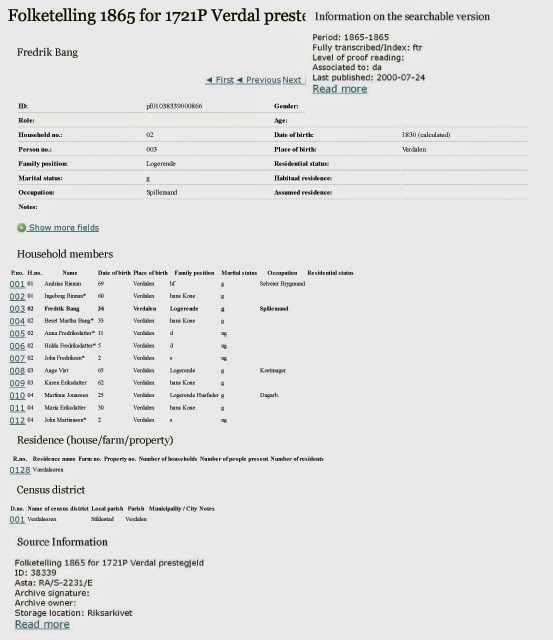
I am part many things, including Norwegian and English. The Norwegians and the Brits (among others) have made many of their genealogical documents searchable online. Here is a Norwegian sample: the 1865 folketelling for my ancestor Fredrick Bang. When I need to translate, these sites often shift to English upon request. And Google Translate sometimes does the trick. Google Translate tells me “folketelling” is Norwegian for "census." His occupation? He was a “Spillemand,” which Google Translate says means "fiddler" in Danish -- Wikipedia says it's Nordic dance music, typically involving the fiddle. Somewhere in my youth I heard that one of my mother’s ancestors was a musician. Perhaps this is the one. Of course, we were told he taught the royals…. Every family has a “royals” story in it, yes?


National Archives UK
As for the Brits, you can visit the Archives and the Guildhall Library in London and at either place touch many old pieces of parchment (I have), but you can also order online. Click here to view the will of my ancestor George Merriman, who died in London in 1656 and mentioned his son Nathaniel “now living in New England.” I ordered a copy of the will from the British National Archives. When I was trying to confirm that Nathaniel was a Puritan, I found his brother John’s marriage allegation at Ancestry.com. It was just gibberish to me, so I googled my way to an English woman who could actually read the 17th century original. Voila, I learned it was what appears to be a pretty standard marriage document.

Daughters of the American Revolution
library, photo from DAR website)
Modern technology made this possible. When my father started working on this tree (c 1970s), it was harder. He built the tree after driving from Minneapolis to Salt Lake to use the Family History Library. While I lived in Washington, D.C., every visit he made included a trip to the Daughters of the American Revolution(DAR) Library or the Library of Congress, or both. He wrote notes long-hand and created hand-written pedigree charts. But no matter how hard he tried to grow our tree, there was simply a lot of data he could never find because he couldn’t go everywhere and see everything.

Before my parents’ time, genealogy was even harder. Before I ever went to the British Archives online to find George Merriman's will (above), I knew there was one, because in 1907 a genealogist named Waters traveled by boat to England to look at it. Can you imagine? He wrote it up in a book called "Geological Gleanings of England" and I found it online at Ancestry.com.  The will was also transcribed in a 1913 book I found at Archive.org while simply searching online for the name “George Merriman.” I liked the Merriman book enough to have a copy printed, generally easy to do at Amazon.com. But until I went online at the British Archives, I never saw it in its original form. There were, of course, no copy machines in in either 1907 or 1913.

Lewis Mills Norton, from History of Goshen
Going back further in American genealogy, there once lived in Connecticut a “Nutmegger” named Lewis Mills Norton (1783 - 1860). He was a church deacon, and got the idea that people might want to have a written record of where they came from. He lived in Goshen, and his decades-long work led to the publication of the History of Goshen many years after his death. . If you go online and open the first few pages of this 652 page book, you’ll learn that Norton “was accustomed to carry pencil and paper wherever he went, and he recognized in every man and woman he met a possible source of wished for information, for which he was not slow to ask, nor negligent to record…. He traveled hundreds of miles, wrote hundreds of letters, examined records of probate courts, of towns, and of families, was often on his knees to read the inscription upon some ancient gravestone, deciphered old accounts and private journals….” (Hibbard, Augustine, “The History of the Town of Goshen, Connecticut, with genealogies and biographies based on the records of Deacon Lewis Mills Norton” (Hartford, CT 1897) at 7.)

Norton was also my “cousin” -- he is actually my first cousin 5 times removed. (That makes him MUCH older than I!) Some time after he died in 1860, his papers were given to the Connecticut State Library in Hartford. Included in those papers is a bound book which contains Norton’s hand-written genealogy of the Mills family.
From Norton's genealogy of the Mills family, on file at the Connecticut State Library
I am not connected to Goshen, but I am a Mills. In this beautifully scribed book, Norton writes about his grandfather Joseph Mills (1728/29 - 1792), mother Charity Mills (1759 - 1843), aunt Penelope Mills (1755 -1814), and her daughter Charity Remington (1788 - >1849). Charity Remington is my 3rd great grandmother. She and Norton were contemporaries and first cousins. She lived in New York and he lived in Connecticut, and I do not know if they ever met. But he meticulously recorded family births, deaths, and places pertaining to his mother’s namesake and many other relatives.

Photo from Connecticut State Library website
I cannot read this precious document at my desk. Indeed, to access it I must travel to Hartford, get a library card from the Connecticut State Library, order the book from an off site archive, return later when it arrives, put all my possessions (other than pad of paper and pencil) into a locker, and go into a “cage” of sorts. I read at a table under the supervision of a staff librarian. I am allowed to photograph pages. And I may ask a librarian to make copies of pages. Rather than collecting payment up front, they send the precious copies to me by mail with an invoice, because, I am told, their patrons always pay.

This book is just one example of why sometimes you need to go there.

I haven’t yet made any trips solely dedicated to “digging up dead relatives” (one of my favorite sayings), but I have been able to tack on dead relative research in London, Boston, New York City, Washington, D.C., Minneapolis, a whole bunch of towns in New England, and, arguably, Aruba (read to end).

I just returned from a family trip to Massachusetts and Connecticut. Before I ever knew I had ties to Massachusetts, I married into a Massachusetts family. I am thus fortunate to have living relatives in Longmeadow, Massachusetts, right on the Connecticut border, only 30 minutes from the Connecticut State Library. When I visit, I spend time with my 87-year-old mother-in-law. I typically bring photos and a tape recorder, and gather stories of my husband’s side of the family. She tells wonderful stories, and they are part of my husband’s and daughter’s family tree and, by extension, mine. I also spend time with my brother-in-law and his family. They are great people, and I value these living relatives more than my dead ones.

These living relatives are also gracious and tolerant enough to allow me to traipse all over the place, taking photos of graves, visiting local libraries, and searching town records. I come back in the evening and share my day’s activities, and they give me the great gift of acting interested. I consider myself VERY fortunate that these living relatives live – by shear coincidence – so near my dead ones!

When my in-laws moved to Longmeadow years ago, I didn’t know that Penelope Mills (above) lived next door in Agawam, Massachusetts in the 1790s. By then she was married to Jabez Remington. Jabez is my most elusive dead relative, and indeed I call him “the elusive Jabez.” I know now that Jabez and Penelope lived in Agawam because the last time I was at the DAR (I extended a business trip for a day in their library), I found a copy of Samuel Flower’s Account Book, which showed Jabez and his family purchasing items at his store in Feeding Hills in the 1790s. Feeding Hills was part of Agawam (thank you Google maps and Wikipedia). I couldn’t have found that account book online—I needed to be at the DAR to access it. And that account book led me to Agawam.

No one in my living family seemed at all surprised that I wanted to attend the First Baptist Church of Agawam (founded 1790) during my recent visit. I’m not a Baptist, but I come from Baptists, and Jabez once declared himself one. Off I went to church. After the service I stayed for pepperoni, cheese, grapes, and cake during coffee hour. When I explained my presence, I was immediately directed to the church historian. She is an older woman from Agawam – her ancestors were founders of the church and unlike my family of roamers, they never moved on. This sweet lady told me she would head home and look for Remingtons in her files. She also introduced me to others as being “from Michigan.” This happens often – New Englanders seem to put all the Midwestern “M” cities into a single bucket. I also learned that the historian has had breast cancer (twice), and seems to know every doctor around town, but she doesn’t know my radiologist brother-in-law…yet. She gave me directions to her house so the next time I visit I can come by. Until then, letters will have to suffice, since she is not much of an internet user.

What other things did I learn on my recent meanderings?

Photo taken Memorial Day week 2014. Grave right, stump left.
I saw the grave of Penelope Mill’s father Deacon Joseph Mills (1728/29-1792) in Norfolk, Connecticut. You can see the death's head with wings iconography of the headstone, and read the stone's stark inscription on the Deacon's grave at Find-a-grave. But it is not the same as standing on a hill amid the old stones and looking at your ancestor’s grave. In some ancient tome I read that his grave was in the shade of a big tree. The tree is gone but the stump remains. Because I was at his grave the day after Memorial Day, I paused to give thanks for the role he played as a town leader during the American Revolution. He also watched his two eldest sons (my uncles) go to war and never return.

During my visit I read Norton’s (perhaps c. 1850?) account of his (Norton’s) visit to his grandfather Mills’ grave. Norton says the graveyard is some three fourths of a mile north from Mills’ home. Norton writes of the grave inscription, and closes with a statement about his “honoured grandfather” who “was a man of humble piety…remarkably affectionate and interesting in his family and elsewhere.” Norton continues, “I do not remember his funeral, and was probably not present being then less than 9 years old. My recollections of him are distinct, as I was standing by him in his Southwest room, telling me bear stories, one of which stories is now clear in my recollection.” Norton didn’t recite the story, which more than 160 years later I regret.

from Johnson-Roberts postcard library
In Norfolk I also visited the public library. I always start in a library, to confirm what I already have in books and capture things not available online. The space was beautiful and the people kind, but there wasn’t much there for me to learn. The Historical Society was closed, but the Town Clerk was incredibly helpful. I found many land deeds involving the Mills family and my elusive Jabez Remington. He signed with a mark—in contrast to his wife Penelope Mills, who could sign her own signature. (That’s my elusive Jabez for ya.) Jabez bought and sold land to relatives and others. And each time he did, his residence was noted in the deed, e.g. Jabez Remington “of Norfolk” or “of Suffield.” Ah, that was news. I hadn’t seen any Suffield records for Jabez. Indeed, no one seems to know who Jabez’ parents were, but there are many Remingtons in Suffield. Had I not been at the Clerk’s office I would not have found this clue to the elusive Jabez! I shall add time in Suffield to my next trip to New England.

In Simsbury, Connecticut and Westfield, Massachusetts I learned that some libraries actually allow you to drink coffee while looking at ancient books. (By the way, the Wisconsin Historical Society also allows this practice, as long as your drink has a lid.) The archivist in Westfield is now looking at boxes of old records from local Baptist churches in search of the elusive Jabez. The genealogist in Simsbury pulled photos of local graves for me, including one of my ancestress Sarah Spencer Case (1635-1691), whose great-granddaughter Susannah Case (1726-1767) married Joseph Mills (above). I spent an hour looking at vital records on microfilm (remember microfilm?) and then headed a few feet away to find Sarah and other dead relatives in their resting places.

At the Free Library I met a fellow DAR member from the Simsbury chapter, named in honor of Abigail Phelps. While in town I also had dinner in a tavern built in 1780. I’m guessing at least one of my ancestors stopped there at some point….. The tavern was originally built by a Pettibone. I descend from American immigrants William Phelps (1593 - 1672) and John Pettibone (1609 - 1638), so these early Simsbury residents are no doubt “cousins” of some sort.

Marker for original Simsbury meeting house, now within cemetery borders
In Simsbury, we talked a bit about where the original church meeting house was built. This was a VERY big deal at the time. It tore the town apart. And I think it might have been one of the reasons my ancestors left Simsbury and moved on, first to Canton and then to Norfolk. That was before the elusive Jabez took them to Westfield, and Agawam, and Suffield (?), and finally to the Finger Lakes of New York where he appears to have died before the 1810 census, which lists Penelope but not Jabez Remington. I came home from this trip with some fresh clues about the elusive Jabez.

At the State Library in Hartford I reread Norton’s book. I had read it on a prior trip, and on this trip I asked for copies of even more pages to be made. I also stated that “I just want to keep this book” – which kicked off a lively discussion with the librarians about which was worse, saying that to an archive librarian or telling a TSA officer you have a gun in your carryon luggage….. (I think the gun business must be worse). I also found the text of the will of Joseph Mills, the father of Deacon Joseph (above). He died in Simsbury in 1783. The will was on microfilm in the State Library. I never got the hang of their microfilm machine, so staff patiently loaded the films for me….

What I have learned on my meandering genealogy trips is that sitting at your desk is not good enough. It is a great starting place, and indeed you can go far sitting in front of your computer screen. But you cannot do it all without visiting your dead relatives. There is nothing like simply being there, where they lived, worked, played and died. There is nothing like meeting the people who work in this field. They are amazingly accommodating and interested in the subject. They are also interesting and fun to know.

There are still many places for me to go as I dig up my dead relatives.

Here is a map with some of the places they lived in Connecticut alone. My next trip to Longmeadow will be in September. I look forward to seeing my living relatives. And my dead ones. And some new friends.

Post script: What am I doing with what I found in all of these places? Yup, I am scanning the documents, posting them to my Ancestry.com tree, where they will leave hints for others. Within days I will find my scanned documents showing up on other people’s trees. These people may not be able to visit these little towns in Connecticut and Massachusetts, and I like the idea that I’m helping them build trees at their desks.

But I won’t do that until I get home. Right now I am putting the finishing touches on this blog while at my favorite vacation spot, the Manchebo Beach Resort in Aruba. The last time we came to Aruba I went to a Dutch.English church service, so I could feel a bit closer to my ancestor Jan Woutersen, who left Old Amsterdam for New in 1659. He never made it to Aruba (he settled instead in Flatbush, NY). But Aruba was a Dutch colony. Perhaps I have "cousins" here? Travel – and technology – are both wonderful. This blog entry is posted from Sunny Aruba.

Photo by friend Yvonne, who blogs at PeripateticDispatches.blogspot.com
Find my dead relatives by using this link (search by name).